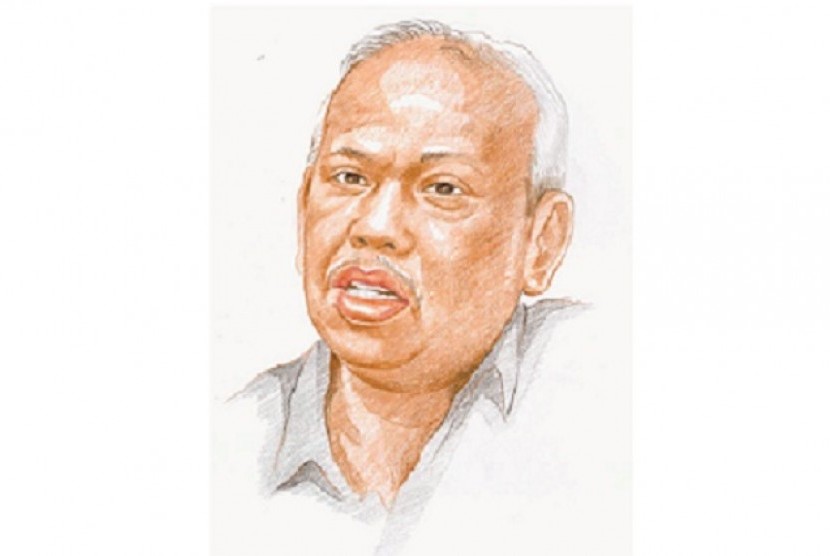
REPUBLIKA.CO.ID, By Azyumardi Azra
Every year the nation celebrates National Education Day on May 2. Each time the thoughts were heard from educational practitioners in particular were more complaint and aggravate of the education policy makers. Because they did not made Indonesia education become more advanced, but even more tied by the process of bureaucratization which continues defined by Ministry of Culture, Elementary, and Secondary Education and now also Ministry of Research, Technology, and Higher Education.
Look at the following indicators. Although, more universal education had already developed since the New Order government through Presidential schools and the establishment of public universities outside Java, until now gross enrollment rate (APK) students and college students were still low.
In recent years, APK for early childhood education (PAUD) were 55 percent, APK for elementary school / islamic elementary school were about 115 percent, APK of junior school level were only about 80 percent, APK high school/islamic high school were about 70 percent, and APK of higher education were about 27 percent. APK of college students aged 7-23 years were only 81 percent (on period 2011-2012).
Although the education budget of Indonesia has 20 percent of the state budget + regional budget, but only about 3.40 percent of GDP; compare with Thailand (5 percent), and Malaysia (7.9 percent). Moreover, smaller funds versus the GDP was not spent wisely and responsibly, so it has not succeeded in improving education in Indonesia both in terms of physical facilities and quality. There were still too many school buildings were damaged and unfit for use far than conducive to the learning process, especially education.
Some people-especially education policy makers- may be apologized by stating, Indonesia education is one of the largest in the world. With the number of student more than 50 million students and nearly 3 million teachers and lecturers with nearly 300 thousand schools and colleges, Indonesia is the largest in fourth place after China, India, and the United States. Given this reality, people could be apologized, that was not easy to take care of education in Indonesia.
Such apologies were simply contra-productive. It will better think to breakthrough step to overcome the various obstacles that made Indonesian education was not also advanced significantly. By doing so, citizens of Indonesia could be more hope on education in Indonesia.
It was clearly, achievement of Indonesia educational was still far from expectations. Until now, education in Indonesia was still in the lowest rank in the fields of mathematics, science, and reading. According to the report of Learning Curve, Achievement Education and Cognitive Ability Index (Pearson, 2014), Indonesia's education is at a level of 40, under Turkey (34), Thailand (35), Colombia (36), Argentina (37), Brazil (38), and Mexico (39), comparing with South Korea (1), Japan (2), Singapore (3), Hong Kong (4), England (6), and US (14).
Seeing this unpleasant reality, efforts must be made. Therefore thought and discussion about the problems of education in Indonesia was still important and should be done by each and all stakeholders.
One of a series of important ideas that contributive to the promotion of education in Indonesia was poured by H.A.R Tilaar in his last book, Theoretical Pedagogic for Indonesia (Jakarta: Kompas, 2015). In the framework of the National Education Day and Anniversary 51st State University of Jakarta (UNJ) in collaboration with the Commission for Culture, Academy of Indonesian Sciences (AIPI), this work was launched through a public discussion with the speaker of Sri-Edi Swasono, UI professor of economics; Dja'ali, Rector UNJ; and the author of this resonance.
Theoretical Pedagogic for Indonesia discussed a number of fundamental problems in education in Indonesia in particular, namely: first, whether theoretical pedagogic or theoretical science education? Secondly, science is universal, but is there a typical Indonesian of science education?
With the 'guide' to that questions, for Tilaar, the fundamental problem concerning education include: The nature of Pedagogic (Education) as Praxis Science; Theoretical Pedagogy and Indonesia Philosophy; Education and Culture of Indonesia; Education processes that deify to Development Interests of the Independent Students; The purpose of National Education; Indonesian Teachers as Tutors; Learning Process which Develop Students Independence; Developing Creativity of Indonesian; and the National Education Direction Toward Indonesia Gold on 2045.
Why pedagogic? According Tilaar, emeritus professor of UNJ, his experiences after getting a professional education as a teacher more than 20 years of work experience of more than 60 years caused unrest. Why? Because, “Science education in Indonesia was actually unborn. Most references to science education of Indonesia [still] come from foreign, especially from the West ".
Furthermore, Tilaar regarded the theoretical pedagogic as a form of applied philosophy which has specific characteristics as a praxis science. With educational praxis someone could be raised consciousness about the freedom he has, which then he must develop it to improve his living standards.
 Ikuti Whatsapp Channel Republika